Berliner Polizei
Sonne und BetonBerliner Polizei enters the story at the point where private wrongdoing becomes a public investigation. Officers respond to the suspected school burglary and address students directly, but their arrival does not immediately produce a confession or a clear suspect. Instead, the investigation sharpens Lukas’s fear that he may be discovered and exposes a wider uncertainty among the characters about whether the police can be trusted to protect them.
Role and Presence
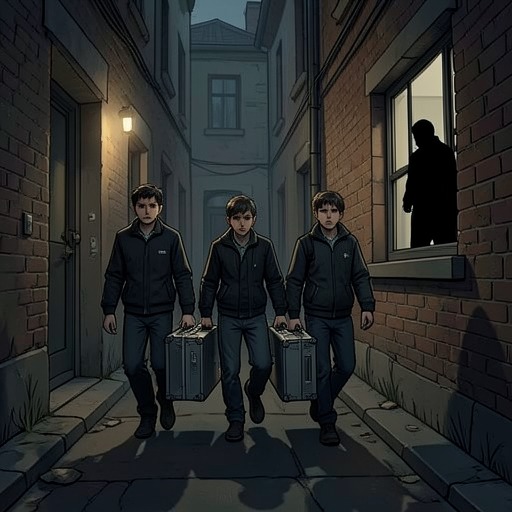
The police are first glimpsed as patrol cars rather than as individual officers. Near a bridge, Lukas and his friends see two cars speed past with sirens on. Julius assumes they are heading to a party; Lukas suspects something has happened. Moments later, boys in black hooded tops run from the embankment beside the school’s equipment room, prompting Lukas to connect their flight with the police presence. The scene establishes the officers’ visibility in the neighborhood but leaves their destination and knowledge unclear.
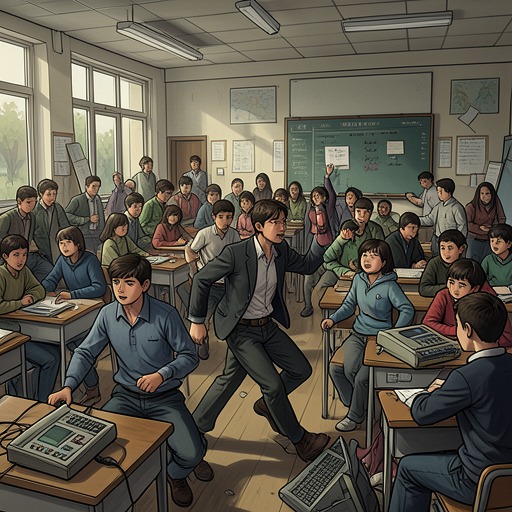
Their later presence at school is more direct. When the principal, Herr Schiezeth, arrives in class with two uniformed officers, Lukas is already sweating and looking for a reason to leave. The police have come to report the burglary, but for him their appearance makes the threat of being identified immediate. The contrast is telling: the officers address the class as a group, while Lukas experiences the visit as if it were aimed specifically at him.
The Burglary Investigation
One officer explains that the school was broken into over the previous weekend, probably on Saturday night. Computers and monitors worth several thousand euros were stolen. According to nearby residents, three male suspects in black hooded jackets transported the goods in a shopping cart toward U-Bahnhof Zwickauer Damm. The officers do not know how the burglars entered the building, and they are still unsure whether reports of gunshots near the station are connected to the burglary or indicate that the thieves were armed.
The briefing conveys both what the investigation has established and what remains unresolved. Witness accounts provide a rough number of suspects, clothing, and a route, but not their identities or their means of entry. The possible connection to gunfire adds another uncertainty rather than a confirmed charge. The officers invite students who witnessed anything to contact Berliner Polizei or share information then and there. Their request turns the classroom into a possible source of evidence, although it does not make anyone speak openly.
The school’s new computers carry a further consequence. Herr Schiezeth explains that the equipment had not yet been publicly announced because he feared that publicity might invite theft. Since, in his account, only people connected to the school knew of the new equipment, he concludes that students must have been involved. This is the principal’s deduction, not a conclusion the officers announce. His anger and promise of punishment for both perpetrators and those who knew but stayed silent intensify the pressure surrounding the investigation.
Witnesses, Suspicion, and Silence
Lukas considers confessing during the police briefing. He thinks the officers already know enough that the perpetrators may soon be found, and wonders whether admitting his part might lead to a lighter punishment. Yet he remains silent. Osman’s apparent interruption briefly frightens him: Lukas wonders whether Osman has seen or heard something, before realizing that the joke is not an accusation. The episode makes the difference between evidence and suspicion especially sharp. A hint or a look can feel like exposure to Lukas without establishing that anyone knows what happened.
After the officers leave, Momo jokes that whoever stole the computers should share the proceeds. Lukas cannot tell whether the remark is an innocent tease or an indication that others have guessed the truth. On a later school morning, classmates whisper, point, and call out to him as if his involvement is already common knowledge. Sanchez tries to reassure him, but three police officers emerge from a stairwell and walk toward them. Their presence intensifies Lukas’s alarm; the scene does not establish that they have identified or formally accused him.
Authority and Perceived Protection
The book distinguishes police from the security staff enforcing the school’s entry rule. When Lukas forgets his student ID, a guard bars him from entering despite his insistence that he attends the school. The guard’s decision is presented as an instance of school access control, not police action. This distinction matters: the officers appear later as investigators, while the guard’s role is to enforce the school’s gatekeeping rule.
The characters’ view of police as a possible source of protection is less assured. When Karin asks Lukas what a young person being robbed on his route should do, he recommends taking a longer bus route through Alt-Buckow to avoid the places where the attackers hang out. His advice treats avoidance as the practical answer, rather than expecting a conversation with the people responsible to solve the problem. Later, when Julius explains the violence in Gino’s home and his plan to obtain Tilidin for him, Lukas asks why they do not call the police. Julius rejects the idea, arguing that the police would not help. This exchange presents that disbelief as Julius’s judgment, not as proof of what the authorities would do in the case.
A separate conversation with Herr Reinicke further complicates the climate around the investigation. Reinicke tries to recruit Lukas to pass on information about the burglary, but does so through racist assumptions about students of immigrant backgrounds and a demand that Germans stick together. He is a teacher, not a police officer, and the book does not present his appeal as a police request. His attempt nonetheless places Lukas under pressure to choose between silence and informing, while exposing how an investigation can be entangled with prejudice even when the formal police appeal is simply for relevant information. The police investigation remains active in the scenes provided, but its outcome is not shown.